


What you need to know about RPM.
One of the most searched questions in the creator world is: “How much does YouTube actually pay per 1,000 views?”
Unfortunately, the answer is both simple and incredibly misleading at the same time. Because two creators can both get 100,000 views and earn completely different amounts of money.
One creator might make £150. Another might make £3,000.
That sounds ridiculous until you understand how YouTube monetisation actually works. Most creators assume YouTube pays based purely on views. In reality, YouTube pays based on advertisers competing for audience attention.
And some audiences are far more valuable to advertisers than others.
What Does RPM Actually Mean?
When creators talk about YouTube earnings, they are usually talking about RPM. RPM stands for Revenue Per Mille, which is essentially how much money a creator earns per 1,000 views after YouTube takes its cut. But this is where things start becoming confusing for many creators, because RPM is not fixed.
A creator posting finance content to a US audience may earn dramatically more than a creator uploading entertainment videos to a global audience, even if both channels receive identical views. That is why comparing earnings between creators online is often incredibly misleading.
YouTube is not paying creators based purely on popularity. It is operating an advertising marketplace, and advertisers pay different amounts depending on who they are trying to reach. That means factors like audience location, watch time, demographics, viewer buying power, audience trust and even the time of year can massively affect revenue.
This is why one creator might make a few hundred pounds from a viral video while another creator quietly earns several thousand from a much smaller but more commercially valuable audience.
Some YouTube Niches Earn Far More Than Others
Advertisers are not paying for views. They are paying for access to potential customers, which means advertisers spend more money in niches where viewers are more likely to buy products or services.
Generally speaking, some of the highest RPM niches include:
Finance
Investing
Business
Software
Technology
Online marketing
Insurance
Education
Why?
Because companies in those industries are willing to spend heavily to acquire customers. A finance company might make thousands of pounds from one customer, so paying higher advertising rates makes sense. Meanwhile, entertainment-heavy niches often earn lower RPMs because advertisers may see the audience as less commercially valuable.
That does not mean entertainment channels cannot build huge businesses. In fact, many entertainment creators eventually make far more through sponsorships and merchandise than they do through AdSense.
But it does explain why “views” alone mean very little.
Geography Changes Everything
Where your viewers come from matters enormously. Generally speaking, audiences in countries like:
United States
Canada
United Kingdom
Australia
Often generate significantly higher advertising revenue than audiences in lower advertising-spend regions. This is because advertisers compete far more aggressively in wealthier markets.
A creator with 100,000 US views may earn dramatically more than a creator with 100,000 views from countries where advertising budgets are lower.
This surprises many creators early on. YouTube is not simply rewarding popularity. It is operating an advertising marketplace.
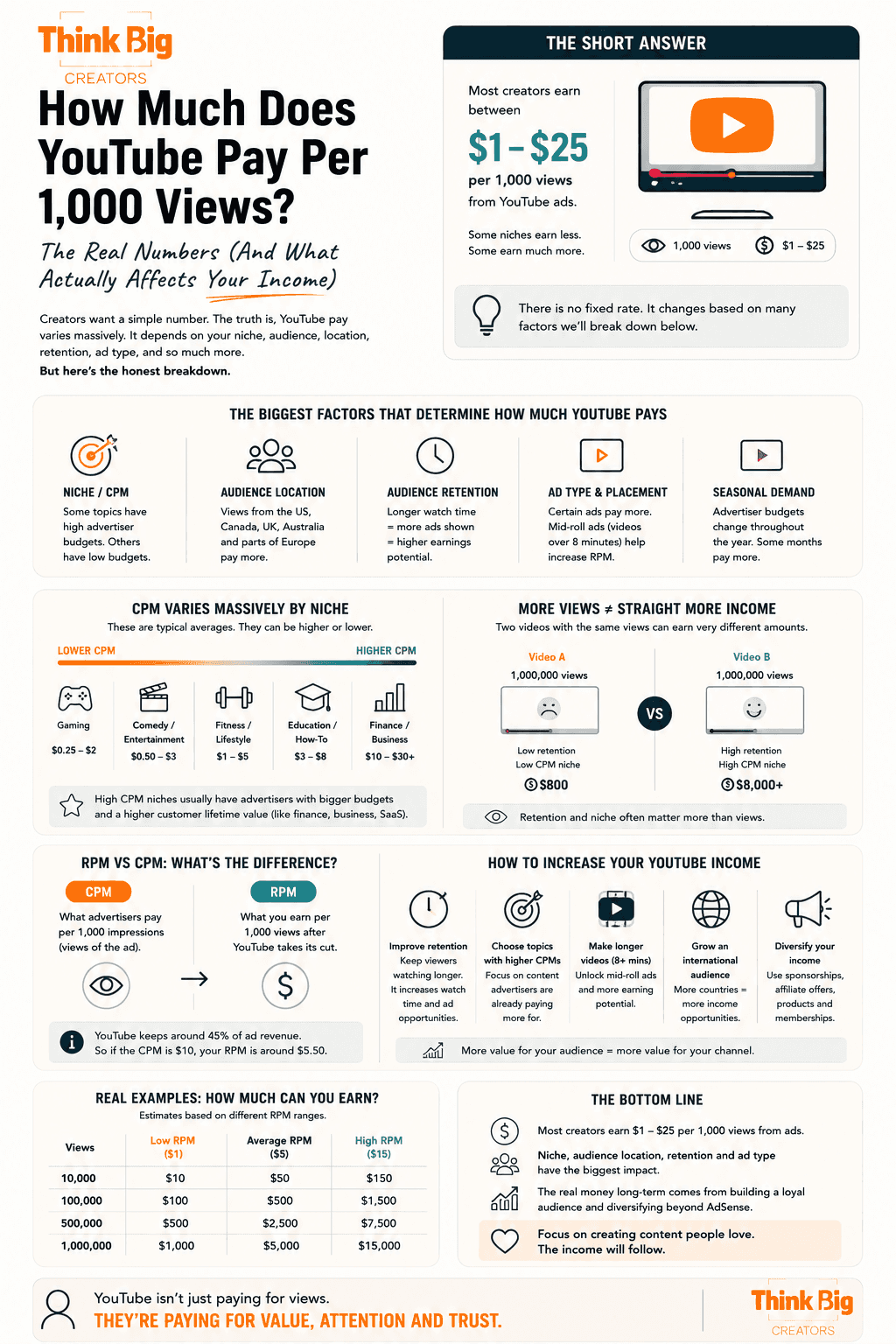
So… How Much Does YouTube Pay?
This is usually the point where creators want a simple answer. Realistically, many monetised channels tend to fall somewhere between roughly $1– $27+ RPM, but that range is enormous. Some creators earn far less. Others earn dramatically more.
And the important thing to understand is that even within the same channel, RPM can fluctuate constantly. A creator might upload one video that earns $5 RPM and another that earns $15 RPM simply because the audience behaved differently, the topic attracted different advertisers, or the timing changed.
Many creators notice this particularly during Q4, when advertisers spend aggressively leading into Christmas. Revenue often climbs sharply during this period before dropping again in January. This is why experienced creators eventually stop obsessing over “how much YouTube pays” as a fixed number.
There is no universal rate. There are simply audiences that advertisers value differently. And increasingly, the creators who earn the most are usually the ones learning how to attract attention that advertisers trust.
The real money usually comes from somewhere else
This is one of the biggest mindset shifts creators eventually make. AdSense is usually only the beginning.
Many creators become obsessed with YouTube ad revenue while ignoring the income streams that often become far more valuable later.
Because once an audience trusts you, opportunities start opening up everywhere. Read this blog here.
Final Thoughts
So, how much does YouTube pay per 1,000 views?
Enough to completely change somebody’s life. Or almost nothing at all.
It depends on:
Your audience
Your niche
Your retention
Your monetisation strategy
Your storytelling
Your viewer trust
That is why successful creators stop obsessing over vanity metrics eventually, because sustainable creator businesses are rarely built on views alone. They are built on attention, trust and the ability to make people genuinely care.
And that is where the real value starts.