


And will longer videos earn more money?
One of the biggest misconceptions on YouTube is that longer videos automatically make more money.
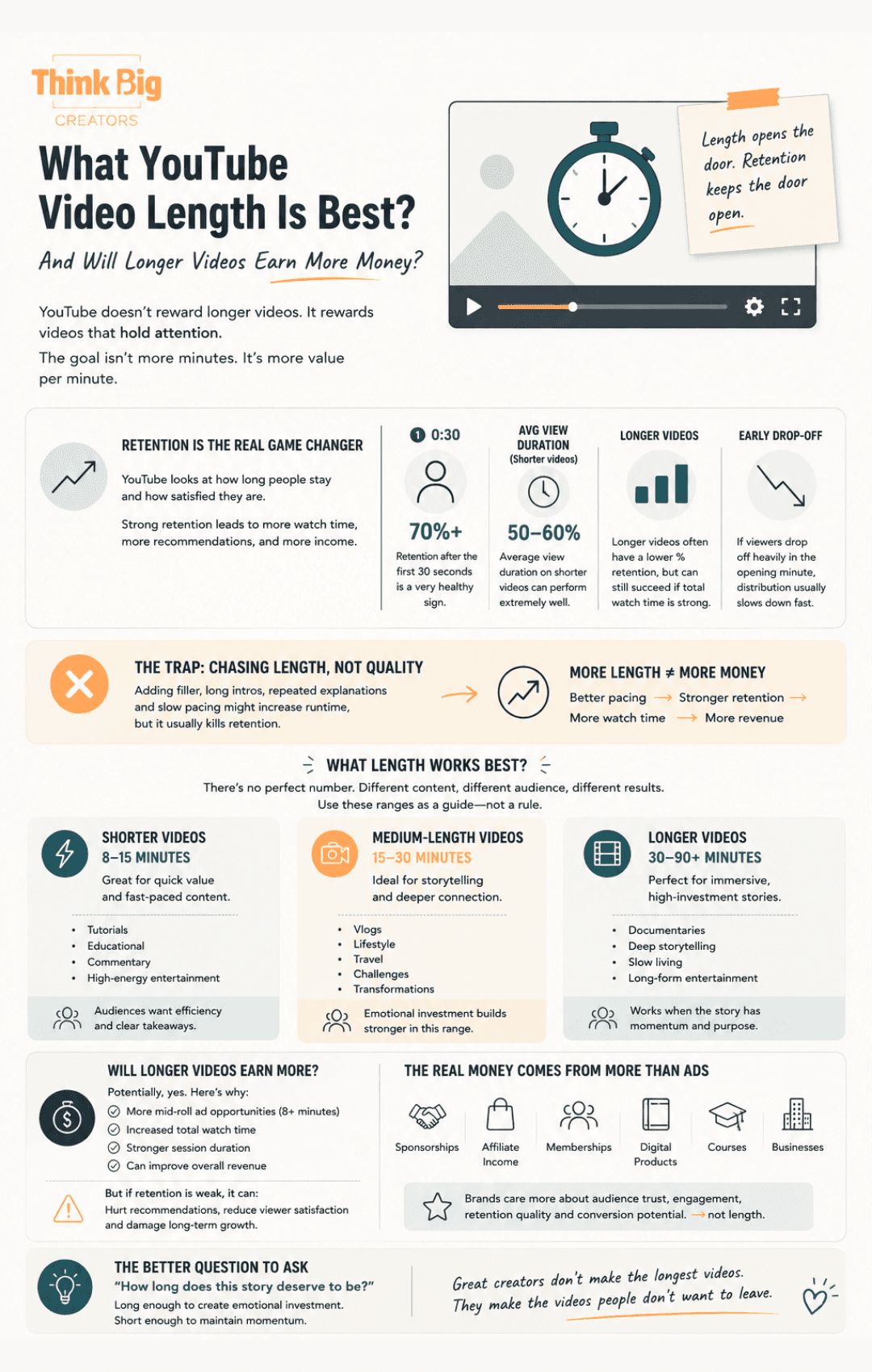
Technically, longer videos can earn more. Videos over eight minutes allow creators to place mid-roll ads, which increases monetisation potential. More watch time can also mean more total ads served, longer viewer sessions, and stronger overall revenue opportunities.
But that does not mean longer videos automatically perform better.
Because YouTube is not rewarding length, it's rewarding attention, and those are two very different things.
A creator can upload a 45-minute video and lose most viewers after four minutes. Another creator might upload a 14-minute video that people watch all the way through. In many cases, the shorter video will outperform the longer one both algorithmically and financially because the audience stayed engaged.
That is the part many creators miss.
Retention is one of the most important signals on YouTube now. The platform watches very carefully how long people stay, when they leave, whether they continue watching other videos afterwards, and whether viewers seem satisfied with the experience overall.
Which is why pacing matters far more than duration alone.
Generally speaking, strong retention often looks something like this:
Around 70%+ retention after the first 30 seconds is usually a very healthy sign
Around 50–60% average view duration on shorter videos can perform extremely well
Longer videos often naturally retain less percentage-wise, but can still succeed if total watch time remains strong
If viewers are dropping aggressively in the opening minute, distribution often slows down quickly.
This is where creators accidentally hurt themselves trying to chase ad revenue.
A lot of people hear “videos over 8 minutes earn more” and immediately start stretching content. Suddenly intros become longer, scenes drag out, explanations repeat themselves and pacing slows down because the creator is trying to increase runtime rather than improve the experience. Viewers feel that immediately.
The irony is that bloated videos often make less money long term because weaker retention damages distribution. If audiences stop clicking your future uploads because they expect slow pacing, growth becomes much harder.
The best creators are not trying to maximise minutes. They are trying to maximise value per minute. That is a huge shift.
YouTube audiences are surprisingly forgiving of long videos when every section feels intentional. Some of the best-performing videos on the platform are 30, 40 or even 90 minutes long. But good long-form content usually has one thing in common:
It does not feel long.
There is momentum.
Questions keep getting answered.
The story keeps moving.
Progress continues happening.
The viewer always feels there is a reason to stay.
That is why some creators can hold millions of people watching hour-long documentaries while other creators lose viewers before the intro has even finished.
Length itself is not the deciding factor. Interest is.
Different types of content also naturally support different runtimes. Tutorials, commentary and fast-paced educational content often work well between 8 and 15 minutes because viewers want efficiency. Lifestyle videos, vlogs, transformations and storytelling content often perform strongly in the 15–30 minute range because emotional investment takes longer to build. Documentary-style videos or highly immersive storytelling can go much longer because the audience is settling in for an experience rather than quick information.
But there is no magical number the algorithm prefers.
The real question is:
How long does this story deserve to be?
Because audiences can feel when creators are respecting their time, and they can also feel when creators are stretching content for monetisation.
One of the most important metrics creators should start paying attention to is not just percentage retention, but where viewers leave. If large numbers drop during long intros, repeated explanations or slow scenes, that is often a pacing problem rather than a topic problem. Many creators think they need “better ideas” when in reality they simply need tighter storytelling.
And interestingly, creators who become excellent storytellers often end up making longer videos naturally anyway, because audiences genuinely want to stay longer with them.
That is a very different thing from forcing length artificially.
It is also important to understand that AdSense eventually becomes only one part of the business for many creators. Sponsorships, affiliate income, memberships, products and separate businesses often become far more valuable over time. Brands care far less about raw video length than creators assume. What they usually care about is:
Audience trust.
Viewer engagement.
Retention quality.
Conversion potential.
Whether viewers genuinely pay attention.
A highly engaged audience watching 15 intentional minutes can often be commercially stronger than passive viewers sitting through a padded 45-minute upload.
And ultimately, that is where sustainable creator businesses are built.
Not by making the longest possible videos. But by making videos people genuinely do not want to leave.