

Most creators are asking the wrong question about YouTube income.
One of the most common questions creators ask is:
“How much money can you actually make from YouTube?”
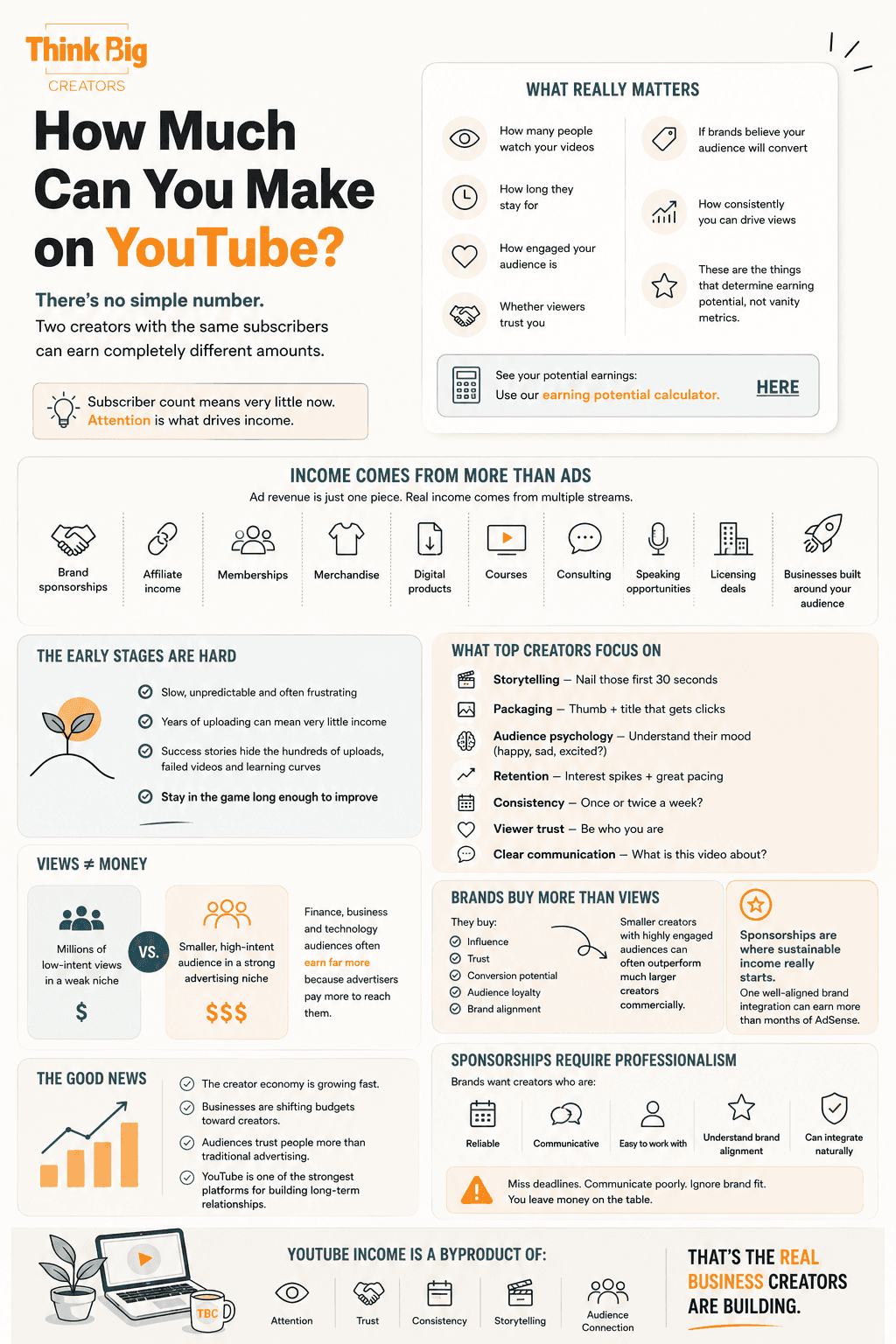
The honest answer is both exciting and frustrating, because there is no simple number anymore. Two creators with exactly the same subscriber count can be earning completely different amounts of money. One channel with 50,000 subscribers might struggle to make a few hundred dollars a month, while another with the same audience size could already be supporting a full-time team and building a serious business.
That’s because subscriber count alone means very little now. What actually matters is attention. Things like:
How many people watch your videos
How long they stay for
How engaged your audience is
Whether viewers trust you
If brands believe your audience will convert
How consistently you can drive views
These are the things that determine earning potential, not vanity metrics.
Have a look at our earning potential calculator to see your channel's results
Most creators also massively underestimate where the real money comes from. Ad revenue is only one piece of the puzzle, and for many established creators it eventually becomes one of the smaller income streams. The biggest shift happens when creators stop thinking like uploaders and start thinking like business owners. Once an audience trusts you, opportunities start opening up everywhere.
For many creators, income eventually starts coming from multiple places:
Brand sponsorships
Affiliate income
Memberships
Merchandise
Digital products
Courses
Consulting
Speaking opportunities
Licensing deals
Separate businesses built around the audience itself. That’s why some creators with relatively modest view counts are quietly building genuinely valuable businesses behind the scenes.
At the same time, expectations matter. Most creators will not get rich quickly from YouTube. The early stages are usually slow, unpredictable and financially frustrating. A lot of creators spend years uploading consistently while earning very little money, not because they are untalented, but because building trust and attention takes time. Unfortunately, social media often hides that reality. People see the success stories, but they rarely see the hundreds of uploads, failed videos, inconsistent income months and learning curves that came first.
The creators who eventually succeed are usually the ones who stayed in the game long enough to improve. Better storytelling, stronger thumbnails, clearer packaging, better pacing and a deeper understanding of audience psychology all compound over time. One strong video really can change the trajectory of an entire channel, but most creators underestimate how much skill development happens before those breakthrough moments arrive.
The creators who tend to improve fastest usually become obsessed with:
Storytelling (think about those first 30 seconds)
Packaging (Thumb and title)
Audience psychology (what mood are your audience in right now, happy, sad, excited?)
Retention (hard to achieve and a complex metric, think storytelling and interest spikes)
Consistency (once/twice a week?)
Viewer trust (be who you are, not who you think you should be)
Clear communication (honesty, what is this video all about)
One of the biggest misconceptions around YouTube income is that views automatically equal money. In reality, a creator getting millions of low-intent views in a weak advertising niche may earn far less than a creator with a smaller but highly valuable audience. Finance, business and technology audiences often command much higher advertising rates than entertainment-heavy niches because advertisers are willing to spend more to reach those viewers.
Audience trust matters too. Brands are no longer simply buying views. They are buying:
Influence
Trust
Conversion potential
Audience loyalty
Brand alignment
That’s why smaller creators with highly engaged communities can often outperform much larger creators commercially. Increasingly, creators are realising that sponsorships are where sustainable income really starts becoming possible. For many channels, a single well-aligned brand integration can earn more than months of AdSense revenue.
But sponsorships also require something many creators overlook: professionalism. Brands want creators who are reliable, easy to work with, communicative and capable of integrating products naturally without damaging audience trust. A creator may have great content, but if they miss deadlines, communicate poorly or fail to understand brand alignment, they often leave significant money on the table.
The good news is that the creator economy is still growing rapidly. Businesses are shifting more advertising budgets toward creators every year because audiences trust people more than traditional advertising. And YouTube remains one of the strongest long-form platforms for building genuine audience relationships that last over time.
The creators who tend to do best long term are not necessarily the loudest or the fastest growing. Usually, they are the ones building trust consistently over time. They learn how to hold attention, communicate clearly, tell better stories and create content that people genuinely care about.
Because at the end of the day, YouTube income is really a byproduct of something else entirely: Attention, trust, consistency, storytelling and audience connection.
That’s the real business creators are building.