


Improve your packaging after going live.
One of the biggest mistakes creators make is assuming a video is “dead” too early.
A video underperforming in the first few hours does not automatically mean the content is bad. Sometimes the packaging simply isn’t helping the right audience understand why they should click, and on YouTube, packaging matters far more than most creators realise.
Your thumbnail and title are not decoration. They are the decision-making layer of the video. They are what determine whether somebody stops scrolling or keeps moving. Which is why changing them after release is not only acceptable it is often the smart thing to do.
But there’s an important difference between strategic optimisation and panic editing every few hours.
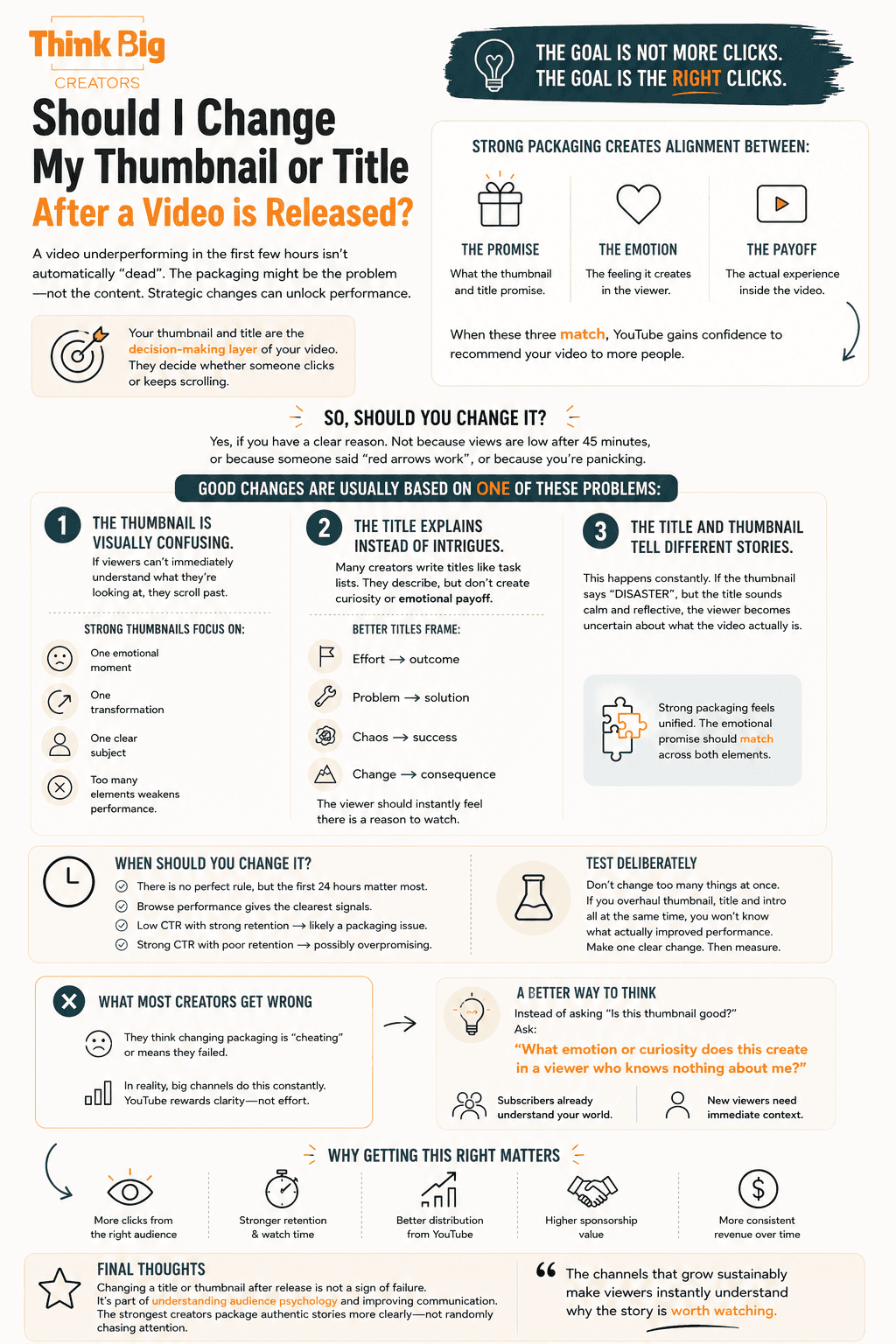
The goal is not more clicks. The goal is the right clicks.
A lot of creators obsess over click through rate in isolation. But a high CTR means very little if viewers leave after 30 seconds because the packaging promised the wrong experience.
The best thumbnail and title combinations create alignment between:
The promise
The emotion
The actual payoff inside the video
When those three things match properly, YouTube gains confidence in recommending the video to more people. This is why changing a thumbnail or title can dramatically improve performance. Sometimes the original packaging simply framed the story incorrectly.
A video about meaningful progress gets packaged like drama. A transformation video gets packaged too vaguely. A great emotional story gets hidden behind literal wording.
The content may be strong. The positioning may not be. So, should You Change It? Yes, if you have a clear reason. Not because views are lower than expected after 45 minutes, not because another creator said “red arrows work" and not because you’re emotionally reacting to the analytics.
Good changes are usually based on one of these problems:
1. The thumbnail Is visually confusing. If viewers cannot immediately understand what they’re looking at, they scroll past.
Strong thumbnails usually focus on:
One emotional moment
One transformation
One clear subject
Too many elements often weakens performance.
2. The title explains instead of intrigues
Many creators accidentally write titles like task lists. “Installing Windows In Our House”, “Fixing The Garden Wall”, “Working On The Roof Again”. These may describe the episode accurately, but they don’t create curiosity or emotional payoff.
Better titles usually frame:
Effort → outcome
Problem → solution
Chaos → success
Change → consequence
The viewer should instantly feel there is a reason to watch.
3. The title and thumbnail tell different stories
This happens constantly, if the thumbnail says: “DISASTER”, but the title sounds calm and reflective the viewer becomes uncertain about what the video actually is. Strong packaging feels unified. The emotional promise should match across both elements.
When should you change it?
There is no perfect rule, but generally the first 24 hours matter most. Browse performance gives the clearest signals. Low CTR with strong retention often points toward packaging issues. Strong CTR with poor retention may mean the packaging is overpromising
One of the biggest traps creators fall into is changing too many things too quickly. If you completely overhaul the thumbnail, title and opening sequence all at once, you lose the ability to understand what actually improved performance.
Test deliberately. Sometimes a tiny wording adjustment changes everything.
What most creators get wrong.
Many creators think changing packaging is “cheating” or means they failed, in reality, large channels do this constantly., because YouTube is not simply rewarding effort anymore. It is rewarding clarity.
The platform needs to understand:
Who the video is for
Why people care
Whether viewers respond positively after clicking
Your packaging helps communicate all three, and sometimes the best-performing version of a video is not the version you originally uploaded.
A better way to think about thumbnails and titles, instead of asking:
“Is this thumbnail good?”
Ask:
“What emotion or curiosity does this create in a viewer who knows nothing about me?”
Because loyal subscribers and new viewers react very differently.
Subscribers already understand your world.
New viewers need immediate context.
That is why simple, emotionally clear packaging almost always performs better than thumbnails overloaded with internal references or overly complex storytelling.
Final Thoughts
Changing a title or thumbnail after release is not a sign of failure. It is part of understanding audience psychology and improving communication. However, the strongest creators are not randomly testing for attention, they are learning how to package authentic stories more clearly. That difference matters because the channels that grow sustainably are usually not the ones shouting the loudest. They are the ones making viewers instantly understand why the story is worth watching.